
Find the hypotenuse
When both legs are known, add their squares and take the square root to find the longest side.
c = √(3² + 4²)
Result: c = 5
The Pythagorean Theorem calculator helps you find the length of any side of a right triangle. Just enter the lengths of two sides, and we'll calculate the third side for you.
Select which side you want to calculate, then enter the values for the other two sides.
Solve for:
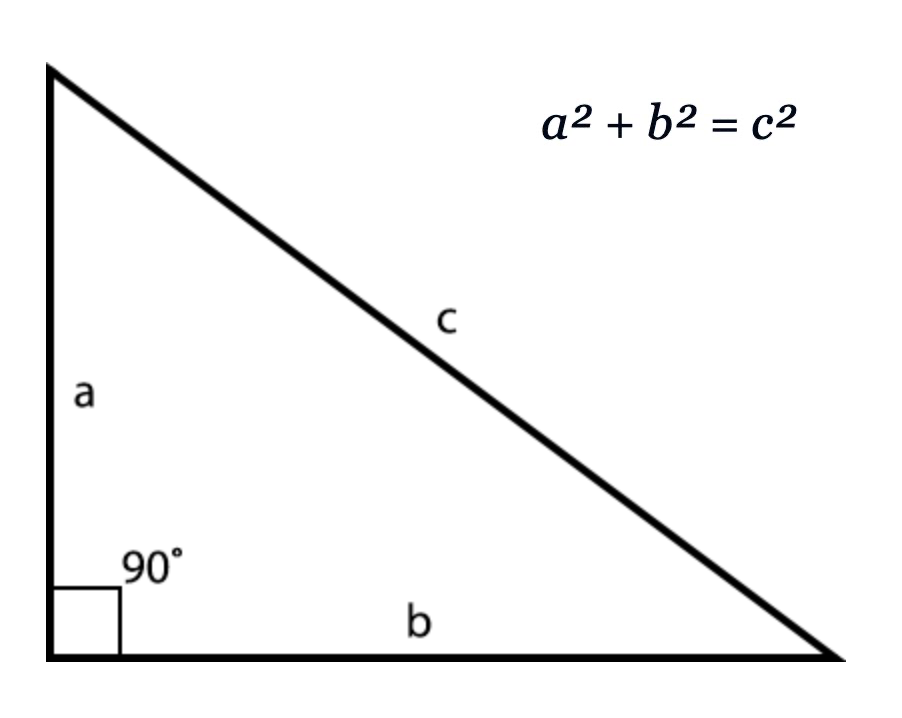
The Pythagorean Theorem states that in a right triangle, the square of the length of the hypotenuse is equal to the sum of squares of the other two sides. It's one of the most fundamental relationships in Euclidean geometry.
If a and b are the legs of a right triangle and c is the hypotenuse, then a² + b² = c². This means we can find any side if we know the other two.
Named after the ancient Greek mathematician Pythagoras (570-495 BCE), this theorem was known to ancient civilizations including Babylonians and Egyptians. While Pythagoras is credited with the first proof, the concept has been discovered independently by multiple cultures throughout history.
Make sure the triangle is a right triangle before applying the theorem. If you are solving for a leg, the hypotenuse must be larger than the other known side.
When both legs are known, add their squares and take the square root to find the longest side.
c = √(3² + 4²)
Result: c = 5
When the hypotenuse and one leg are known, subtract squares before taking the square root.
a = √(13² - 5²)
Result: a = 12
Many geometry problems use familiar triples to verify side lengths quickly.
5² + 12² = 13²
Result: 25 + 144 = 169
You can use it only for right triangles, where one angle measures exactly 90 degrees.
The hypotenuse is the side opposite the right angle, and it is always the longest side of the triangle.
If the known hypotenuse is not longer than the other known side, the triangle is not valid for the theorem and the square root step would fail.
No. For non-right triangles you need other formulas such as the law of cosines or the law of sines.